Followers

Showing posts with label Yamaguchi. Show all posts

2016/06/28

Hofu Tenmangu

Hofu Tenmangu (防府天満宮), located in Hofu city (防府市), Yamaguchi Prefecture (山口県), is one of the three main shrines dedicated to Tenjin (天神), Michizane Sugawara (菅原道真). The other two major Tenmangu include Kitano Tenmangu (北野天満宮) in Kyoto and Dazaifu Tenmangu (太宰府天満宮) in Fukuoka.

Rohmon Gate (楼門)

The shrine claims to be the oldest Tenmangu estabiished a year after the death of Michizane Sugawara in AD 904. The precinct of the shrine is believed to be one of the places where Michizane Sugawara stopped by when he was exiled to Dazaifu (太宰府) where he passed away in 903. Fujiwara clan members who plotted his downfall believed that Michizane passed away with grudges...


The first Torii gate
Soon after his death the Kyoto citizen in the capital suffered from natural disasters. Since the dehydration persisted since his death, the ritual ceremony to pray for rain took place in June 26th, 930. After the praying dark and thick clouds appeared and covered the Heian capital. 

In principle, the ceremony was successful!!! 
Except the following unexpected incident...


Shimenawa pillars
An after the long-awaited rainfall, the palace was struck by lightning, resulting in several casualties who grabbed the power in the palace. Three months after eyewitnessing the unprecedented disaster, Emperor Daigo passed away.  Based upon the "coincidence", Michizane is worshipped as Tenmandaijizai Tenjin (天満大自在天神).

In AD 909 Tokihira Fujiwara (藤原時平), who expelled Michizane, passed away at the age of 39. Besides epidemic diseases were rife all over. Prince Yasuakira (保明親王), the second son of Emperor Daigo, passed away in AD 923 and his son, Yoshiyori (慶頼王), grandchild of Emperor Daigo, passed away, too in AD 925.


The statue of cow is always somewhere in Tenmangu shrine because there are several folklore saying that "Michizane's Chinese animal is cow", "He had a ride in cow when he was exiled to Dazaifu.", "He loved cow and was loved by cow.", "Cow saved him from assassination.", "The place of Dazaifu Tenmangu was assigned by his cow.", and s on... Cow is considered as a Messenger of God" in Tenmangu shrines.


Tenmangu is located in the Hofu city center and contributed to the development of the town since its foundation.


Panoramic view of the town is all yours (free of charge)!


2016/05/14

Iminomiya Shrine

Iminomiya Shrine (忌宮神社) is the second prestigious shrine (Ninomiya/二ノ宮) in Nagato Province (長門国 currently a part of Yamaguchi Prefecture). The precinct of shrine is considered to be the place where 14th Emperor Chuai (仲哀天皇) stayed for seven years during his conquest of Kumaso (熊襲平定) and built the Palace called Toyoura no Mia (豊浦宮) in AD 192.


The enshrined deities are Emperor Chiai, of course, his wife, Empress Jingu (神功皇后), and their offspring, Emperor Ohjin (応神天皇).


After taking government affairs there for 7 years there, Emperor Chuai, along with Empress Jingu, moved to Kashiigu (please check my entry) in Tsukushi Province. In AD 199, Emperor Chuai passed away...


According to the Nihon Shoki, Empress Jingu led an army in an invasion of Korea and returned to Japan victorious after three years. However, there is no evidence of her rule in any part of Korea. Anyway, it is said that she stopped by 

Iminomiya Shrine on her way back from Korea and enshrined her husband, Emperor Chuai in the shrine...


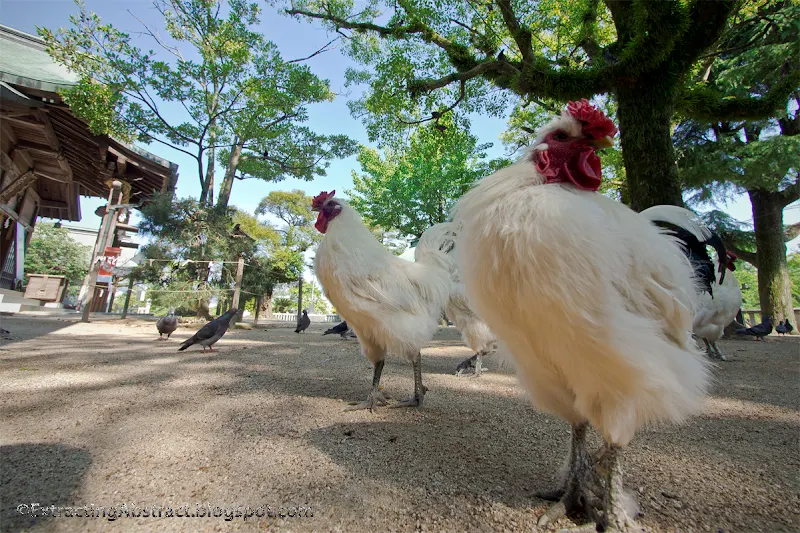
As you can see in photos, there are tons of pigeons and some chickens all over and I was just overwhelmed by them... Well, to be honest, I was bit scared at them (yes, I am a chicken-shit) but the local lass had no problem with getting along with them!


2015/10/25

Sumiyoshi Shrine In Shimonoseki City Part 2


This is part 2 entry of Sumiyoshi shrine (住吉神社) in Shimonoseki city.


To the eastern part of the shrine there is a big and old camphor tree that is believed to be planted by Takenouchi Sukune around 1800 years ago. To be precise, the current tree with the trunk 60 meter in girth grows from an old stump. 

Divine tree planted by Takenouchi Sukune

Takenouchi Sukune is enshrined in the middle of Main hall, facing just in front of Haiden hall. When you stand in front of Haiden hall and ring the bell in the middle, then you are praying to him. 

"Why is he enshrined there?", you may wonder.

He is a legendary statesman serving under fifth emperors (KeikoSeimuChuaiOhjin, and Nintoku). Although there is no reliable record in terms of his age, he is known for his longevity. For instance, according to Mizukagami (水鏡) that was written in the early Kamakura period around 1195, he passed away at the age of 280 in Nintoku 55th (AD367).
According to Kojiki, twenty seven clans declared to be descendent from him. These clans include Soga (蘇我), Kose (巨勢), Ki (), and so on... He is enshrined at several shrines such as Koura Taisha (高良大社), Ichinomiya in Chikugo Province, Ube shrine (宇倍神社), Ichinomiya in Inaba Province, and a couple of more.


1 Yen issued in 1916


His portrait was featured in the old version of banknotes of the Japanese yen

2015/10/18

Sumiyoshi Shrine In Shimonoseki city

Sumiyoshi shrine (住吉神社) in shimonoseki city (下関市) is the most prestigious shrine called Ichinomiya (一宮) in Nagato Province, (長門国), an ancient district located at the far-western part of mainland Honshu. Along with Sumiyoshi Taisha in Osaka (大阪住吉大社and Sumiyoshi shrine in Hakata (博多住吉神社), the shrine is one of the three biggest shrines worshipping three deities called "Sumiyoshi sanjin (住吉三神)" a generic name for Sokutsutsunowo (底筒男), Nakatsutsunowo (中筒男), and Uwatsutsunowo (上筒男). They were born when Izanagi (伊邪那岐) had a purification ceremony called "misogi ()" soon after he managed to escape from the Land of Yomi (World of darkness/黄泉の国). Interestingly, this story only appears in Kojiki.


Both chronicles, Kojiki and Nihon shoki, mentioned that Izanagi had misogi in the river (or brackish water) at Awagihare in Tachibanano oto in Tsukushi, Himuka (筑紫の日向の橘の小戸の阿波岐原), which is considered to be in current Fukuoka city. The name of this place is phrased in Norito (祝詞), an ancient Japanese Liturgy.

Image from Wikipedia
As you can see from the photo above (image from Wikipedia) main hall, built in AD1370 and registered as national treasure (国宝), is composed of five compartments where five deities are individually enshrined - from left to right (west to east), Sumiyoshi sanjin (住吉三神) in the first hall, Emperor Ohjin (応神天皇) in the second, Takenouchi, Sukune (武内宿禰) in the third which faces to Haiden hall (拝殿), Empress Jingu (神功皇后) in the fourth, and Takeminakata (建御名方) in the fifth. It is said that the aratama (=brutal soul/荒魂) of Sumiyoshi sanjin is enshrined in Shimonoseki Sumiyoshi shrine, whereas their nigitama (= harmonious soul/和魂) is enshrined in Osaka Sumiyoshi taisha.


The history of the shrine started off when Empress Jingu and her troops returned from Korea for reign. Although Japan chronicles argued that her troops conquered southern part of Korea, there is no historical evidence supporting her reign in Korea (see this link for more detail).


According to Nihon shoki, Sumiyoshi Taijin (住吉大神 = Sumiyoshi sanjin) supported to nagivate her troops to safely land to Silla (新羅). Three years after her stay in Korea, Empress Jingu received an oracle from Sumiyoshi Taijin to enshrine brutal spirit at Yamadanomura (山田邑) in Nagato province and appointed Anatonoataehondachi (穴門直践立) to be the principal priest. Upon request Anatonoataehondachi  built small shrine (祠) in the place where current Sumiyoshi shrine is located.


During the reign of the 13th Emperor Seimu (成務天皇 AD131-191), spirits of Emperor Ohjin, Takenouchi no Sukune, and Empress Jingu are transferred from Umi Hachimangu (宇美八幡宮) in Fukuoka prefecture. Takeminakata was enshrined much later but we are not certain when it exactly was...

Small divine bridge (神橋)

Unfortunately the construction went on when I visited but the weather was undoubtedly beautiful.


To be continued

2015/09/06

Kintai Bridge

When I returned from the trip to Mijamija Island, I stopped by at one of the most famous (in a bizarre way) bridges in Japan. It is called Kintai bridge (or Kintaikyo bridge/錦帯橋橋) that was built in 1673.


The bridge consists of five arches made of wood. The bridge has 193.3 meter long and 5 meter width to spans across Nishiki river (錦川),  


Until Meiji restoration only Samurai and wealthy local merchants were allowed to cross the bridge. At present, fee to cross bridge costs 300 JPY (adult). The toll gate is open from 8 to 17, however, it is possible to cross bridge before/after opening hours as long as you drop entrance fee in the box located at toll gate.


Alternatively you can cross river by boat!


2014/10/18

Kikugahama in Hagi City

Thanks to the warm hospitality of a local friend, Kuchiba-san, I was introduced to several sightseeing spots in Hagi city (萩市) in Yamaguchi Prefecture.


The place is called Kikugahama (菊が浜) beach and this is her favorite place to visit. I agree!


2014/06/02

Shoin Shrine in Hagi City

I had a chance to visit neighboring cities thanks to the generous offer from a Yamaguchi native!


There are two Shoin shrines (松陰神社) in Tokyo and Hagi city in Yamaguchi and I, of course, visited the latter one.
The first Torii gate taken by Infrared camera
I think almost all Japanese can recognize him as one of the indispensable personnel in achieving Meiji Restoration (明治維新).


Probably due to his given name, Sho (松= pine) in (陰), lots of pine trees are planted there.


2014/05/28

Tsunetomi Hachimangu in Yamaguchi City

Currently, I have a short stay in Yamaguchi city, located at the very western tip of the mainland, for around four weeks. This is my first weekend and I rambled new neighborhood on Sunday.


Sure, I visited a couple of local shrines! Two shrines are combined there: Tsunetomi Hachimangu (恒富八幡宮) and Takakurakou Shrine (高倉荒神社). Since it's named Hachimangu, Hondawakenomikoto, also known as Emperor Ohjin (応神天皇) is enshrined in Tsunetomi Hachimangu, as well as Ichikishimahime no mikoto (市杵嶋姫命), Takirihime no mikoto (多紀理毘売命), and Tagitsuhime no mikoto (多岐都比売命).

Tsunetomi Hachimangu taken by Infrared camera
On the contrary, Takakurakou Shrine enshrines Sumanoo (須佐之男神) and Ukemochi (保食神)


It's a brand new building as they lost almost all buildings by fire in February 2002 (local newspaper article here in Japanese).